Memories of the Cold War: Movies and Dramas in the Kim Jong Un Era
- Commentary
- January 09, 2026
- Youngsun JEON
- Professor, Humanities Research Institute, Konkuk University
Young-sun Jeon, Professor at Konkuk University, examines the evolution of North Korean films and dramas during the Kim Jong Un era, noting that while production volume has sharply declined, the directing and storytelling have become significantly more sophisticated. He specifically highlights that recent works focus on "counter-espionage" (bantam) narratives—centered on protecting the Supreme Leader from external threats—as a key mechanism to strengthen internal cohesion. Furthermore, Professor Jeon sharply investigates the current state of North Korean popular culture, which utilizes Cold War sentiments as a tool for regime maintenance by emphasizing intergenerational loyalty through the depiction of young female heroes.
■ See Korean Version on EAI Website
The Role of Art in the Kim Jong Un Era
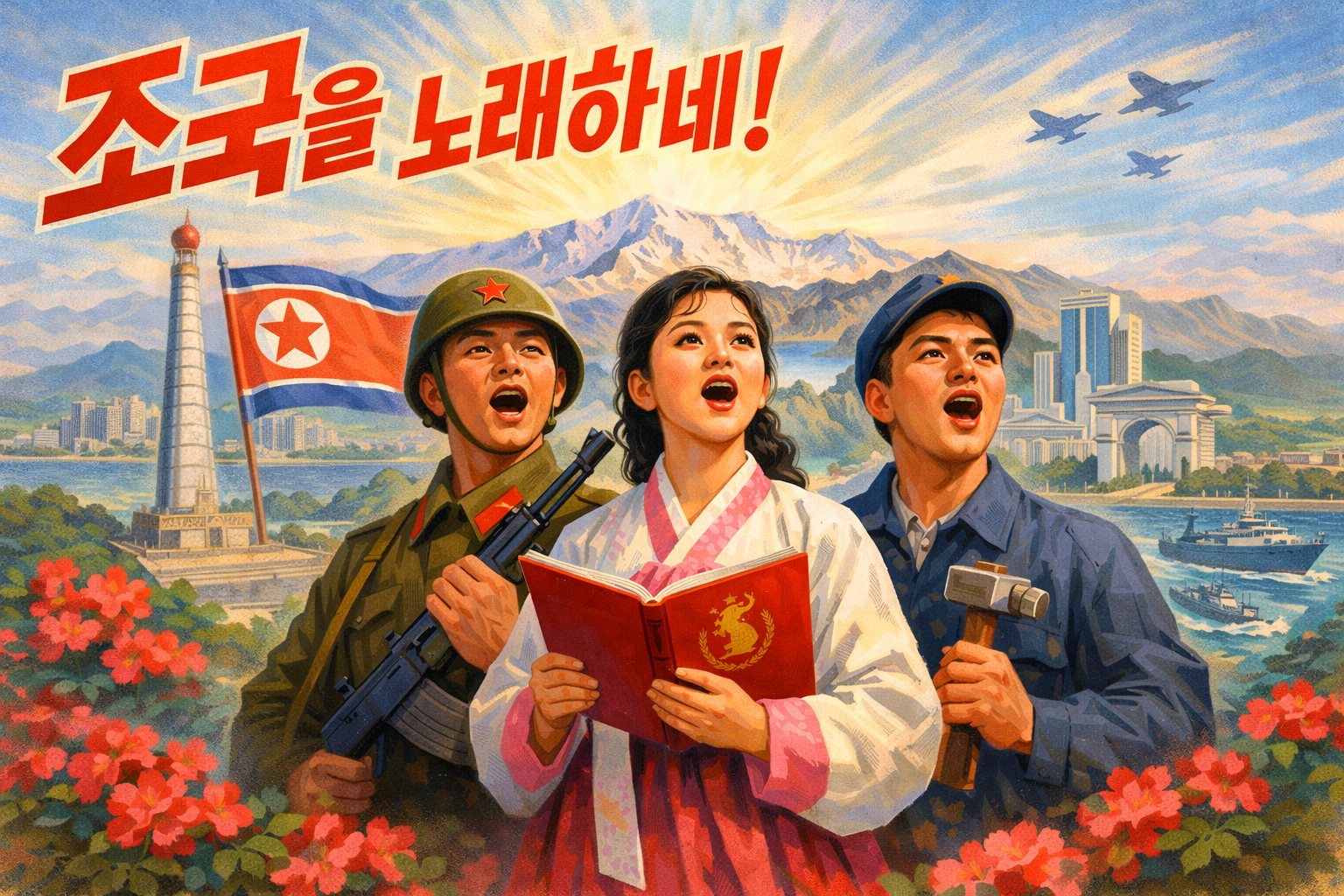
As is well known, North Korean literature and art exist for the purpose of regime propaganda. The fundamental objective of North Korean literature and art is to propagate the policies of the Workers' Party and to ideologically educate the people. This objective has remained intact from the establishment of the North Korean regime through to the Kim Jong Un era. Among literature and arts, long-form narratives such as literature, films, and dramas are planned with themes and subject matters desired by the Workers' Party. Once a theme is determined, the subject matter that best demonstrates the theme is selected, and the work is completed using permitted directorial methods. It shows not what the people want to see, but what the regime wants the people to see. This is also the reason why one can confirm the Workers' Party's policies through North Korean films and dramas.
Unlike the Kim Jong Il era, film and drama production in the Kim Jong Un era is limited. Although the Kim Jong Un regime began in 2012, considering production time, films and dramas of the Kim Jong Un era would be those released after 2013. From 2013 to 2025, there have been only about ten new films and dramas. In terms of the number of productions, this is incomparably fewer than during the Kim Jong Il era. Most cinema or broadcast time is filled with repeated screenings of previously produced works rather than the creation of new ones.
The stagnation of the arts community is a problem that Kim Jong Un himself has strongly rebuked. Kim Jong Un reprimanded the stagnation of culture and arts at the 9th National Conference of Artists in 2014, the 'Review of Work' at the 7th Congress of the Workers' Party of Korea in 2016, and the policy speech at the 1st Session of the 14th Supreme People's Assembly in 2019. This cannot be viewed as a problem of production costs. Films and dramas were made even during the "Arduous March."
The reason for the stagnation of art in the Kim Jong Un era is due to a change in its role. In the Kim Jong Il era, artists were the core resources of propaganda work. However, the core of propaganda work in the Kim Jong Un era is the grassroots organizations of the Workers' Party. Organizations such as the Cell Secretaries or Primary Party Committees have been assigned to handle propaganda work. In the basic organizations of the Workers' Party, which are at the forefront of daily life and production sites, propaganda work is conducted using specific materials and multimedia tailored to the reality of the field.
Artists are required to produce works with international competitiveness. Rather than creating many works to be moderately used for propaganda and agitation, the demand is for high-density works through selection and concentration of party policy propaganda. In fact, compared to the Kim Jong Il era, the number of produced works has decreased significantly. However, the quality of the products has risen noticeably. The storylines have become more solid, and the direction has become bolder. The fast pacing and the more sophisticated, popularized directing style make it difficult to recognize them as North Korean works.
'Counter-Espionage' as the Center of Narratives in the Kim Jong Un Era
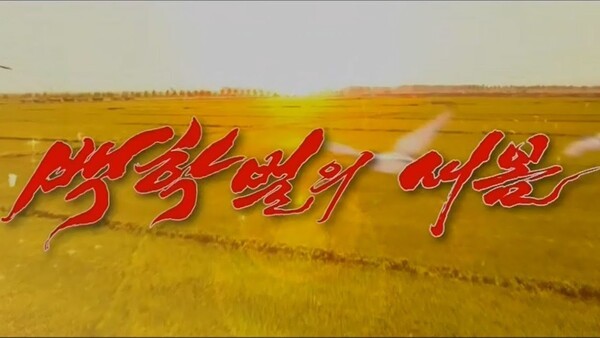
Films produced after 2013 include The War Without Gunfire (2014), The Story of Our Home (2016), One Day and One Night (2022), 72 Hours (2024), and Day and Night of Confrontation (2025); dramas include Bulletproof Wall (2015), Ginseng Diggers of the Imjin Year (2018), The Last Point (2022), Memoirs of a Prosecutor (2023), and New Spring in Baekhak-beol (2025). Although North Korea distinguishes between films and dramas, the genre distinction holds little significance. The War Without Gunfire (2014) is a film but was produced in the format of a 5-part drama, and 72 Hours (2024) is a film over 4 hours long that was released in two parts. Day and Night of Confrontation, created in 2025, is a two-part film that continues the content as a sequel to One Day and One Night from 2022. The drama New Spring in Baekhak-beol (22 episodes), aired in 2025, was screened in movie theaters in bundles of two episodes.
What is important is the theme. It matters which theme is handled and in what manner. Films and dramas produced in the Kim Jong Un era do not deal with small themes directly related to daily life or economic sites. They display themes associated with the policies aimed at by the Kim Jong Un regime in the desired manner.
What is most notable is that 'counter-espionage narratives' (반탐, Bantam) are central. 'Bantam' refers to 'stories about catching spies.' The opposite of counter-espionage is 'espionage' (정탐, Jeongtam), which means gathering information. Espionage works are spy stories about entering enemy lines, deceiving, and retrieving information. Although counter-espionage and espionage are distinguished by genre, in reality, there is no clear boundary. This is because one sometimes disguises oneself as the enemy to stop a conspiracy.
Counter-espionage works have popular appeal. It is a genre with strong mass appeal, featuring intricate brain games of deceiving and being deceived, as well as action. Narratives where one performs a seemingly impossible mission through elaborate strategies of deception and sacrifice, and then returns, offer a sense of reversal and the thrill of victory. It is an attractive genre as a means of ideological education because it can educate about spies and instill patriotism through narratives of victory. In North Korea, many counter-espionage works were produced from the 1950s to the 1980s.
Counter-espionage works of the Kim Jong Un era include the films The War Without Gunfire (2014), One Day and One Night (2022), and Day and Night of Confrontation (2025), and the dramas Bulletproof Wall (2015) and Memoirs of a Prosecutor (2023). Half of the films and dramas in the Kim Jong Un era are counter-espionage works. In these works, the target that the spies aim for is 'Kim Il Sung.' That is, counter-espionage works in the Kim Jong Un era are set up as a confrontation between forces trying to eliminate Kim Il Sung and the figures who prevent this.
The film The War Without Gunfire (2014) is a 5-part espionage film set around the liberation in 1945. After the liberation on August 15, 1945, the U.S. Far East Command prepares an 'anti-North Korea operation' to eliminate North Korea using the Black Dragon Society, a Japanese special agency. The protagonist Nam-hui, who grew up remembering her father who died in a Japanese prison while fighting for independence, disguises herself as Sumiko to steal 'MacArthur's 11-point directive' intended to eliminate North Korea.
The drama Bulletproof Wall (2015) is a 14-part drama set from 1944 to immediately after the liberation in 1945, detailing the activities of a shield agent countering a poisoning operation intended to eliminate the heart of the People's Army guerrilla unit. Parts 1 through 7 cover the activities of Jung Jin-beom, who acts as a shield agent while bearing the stigma of being a pro-Japanese businessman, and parts 8 through 14 follow the storyline of Jung Ok-geum, who succeeds her father as a shield agent, eliminating the poison dart headed for the headquarters.
One Day and One Night (2022) and Day and Night of Confrontation (2025) are films modeled after a real figure Ra Myung-hui (Ra Myung-ju in the play), a 'Hero of the Republic and War Veteran.' The story involves Ra Myung-ju risking her life to stop a conspiracy to eliminate Premier Kim Il Sung.
Memoirs of a Prosecutor (2023) depicts the activities of Choi Hyung-kyu, Deputy Prosecutor General of the People's Army Supreme Prosecutor's Office, who uncovers the conspiracy of Ri Seung-yeop to eliminate Kim Il Sung, starting with the attempted terror incident against Kim Il Sung in August 1950 during the Korean War. Even in a situation where he is sentenced to death by firing squad due to a frame-up and his wife and daughter are kidnapped, he proceeds with the investigation, resolving that 'there must not be a single inch of error in guarding the Supreme Commander.' He protects [the leader] with his death in order to catch Ri Seung-yeop, the Minister of Justice and Chairman of the People's Inspection Committee.
Hereditary ‘Suryong’, Hereditary Death-Defying Defense of the ‘Suryong’
The reproduction of counter-espionage works in the Kim Jong Un era aims to strengthen internal solidarity by emphasizing external threats. The core of strengthening internal solidarity is the 'Suryong' (Supreme Leader), leading to the ideological education of 'death-defying defense of the Suryong,' which implies that one 'can live' only by protecting the Suryong. Absolute respect for the Suryong is a fundamental virtue of morality in the North Korean system. Among the morals emphasized in North Korea, the highest is taught to be the "noble demeanor" of "longing for and following only one's leader in times of joy or hardship." Devotion and sacrifice for the Supreme Leader, and a life lived for society and the collective, are taught as the highest morals and values.
The death-defying defense of the Suryong Kim Il Sung leads directly to the death-defying defense of Kim Jong Un. The thematic consciousness that revolutionary traditions must be continued through hereditary loyalty and hereditary defense of the Suryong is confirmed by the setting of hereditary loyalty. The drama Bulletproof Wall, where a father self-destructs to protect the 'Headquarters of the Revolution' and is followed by his successor protecting the Suryong, and The War Without Gunfire, where a daughter succeeds her father who died working for independence to disguise herself as 'Matsuoka Sumiko' and reveal MacArthur's war plans, are mass educational materials for 'revolutionary tradition education' with the message that 'the leadership of the revolution must be protected generation after generation.'
Since the beginning of the Kim Jong Un regime, counter-espionage themed films and dramas have been continuously produced despite the situation where film and drama production has not shaken off extreme stagnation. It can be confirmed that counter-espionage works are essential content in the Kim Jong Un era. In particular, the drama Bulletproof Wall was rebroadcast in 2016, 2017, 2018, 2019, and 2020 since its first airing in 2015. In 2020, it was aired twice, making it a total of seven broadcasts. It has been noted as educational content for hereditary loyalty for Suryong Kim Jong Un.
North Korea presented the 4 Major Educations (Faith Education, Class Education, Patriotism Education, Moral Education) in June 2014, and then revised them to the 5 Major Educations (Greatness Education, Kim Jong Il Patriotism Education, Faith Education, Class Education, Moral Education) in December. Subsequently, at the 8th Congress of the Workers' Party of Korea in 2021, 'Greatness Education' and 'Kim Jong Il Patriotism Education' were changed to 'Revolutionary Tradition Education' and 'Loyalty Education.' While emphasizing revolutionary tradition, education on loyalty to Kim Jong Un as the new Suryong was strengthened. In alignment with Kim Jong Un's ascension to Suryong, education about Kim Jong Un as the successor of the revolutionary tradition was reinforced.
The theme that 'the Suryong must be protected' became particularly distinct after 2019. In a 'letter sent to the 2nd National Conference of Primary Propaganda Workers' held immediately after the Hanoi Summit in 2019, Kim Jong Un stated, 'Do not mystify the Suryong.' He said, "The Suryong is not a being separated from the people, but a leader of the people who shares life and death, joy and sorrow with the people and devotes himself to the happiness of the people." This instruction by Kim Jong Un indicates the meaning of how the Suryong should be treated and how the relationship between the Suryong and the people should be defined. Education was conducted in a way that implies: since the enemy is waiting for an opportunity 'by all means to overthrow our socialist system,' 'we must protect our Suryong with our lives.'
Thus, North Korean films and dramas from the 2020s onwards depict the Suryong not as an absolute, flawless being, but as a being that the people must protect and guard, portraying the people who protected the Suryong as heroes. Also notable is that the heroes protecting the Suryong are young women. In the films The War Without Gunfire (2014), One Day and One Night (2022), Day and Night of Confrontation (2025), and the drama Bulletproof Wall (2015), the figures who protect the headquarters of the revolution and Premier Kim Il Sung are all young women. Although not a counter-espionage work, the protagonist of The Story of Our Home (2016) is an 18-year-old maiden, and the protagonist of The Last Point (2022) is 19 years old. They are figures who, as frail and weak women, protected the Suryong, devoted themselves to Kim Jong Un, and made their fatherland known on the world stage. Figures that young people should emulate are discovered and made into films and dramas, utilizing them as a field for experiencing revolutionary tradition.
Since the beginning of the Kim Jong Un regime, control for hereditary succession and crisis management has been further strengthened. It is a situation without a clear breakthrough. Control justified by internal solidarity will also lose its effectiveness. However, there is a limit to what can be solved by control alone. Films and dramas of the Kim Jong Un era are the product of the meeting between unavoidable popularity and the theme of defending the Suryong. Within that, memories of the Cold War are being actualized through Cold War sentiments and Cold War sensibilities. ■
■ Youngsun JEON is a Professor at the Humanities Research Institute at Konkuk University.
■ Translated and edited by Inhwan OH, EAI Senior Research Fellow; Sangjun LEE, EAI Research Associate
For inquiries: 02 2277 1683 (ext. 211) | leesj@eai.or.kr