Preemptive Strike Scenarios on the Korean Peninsula and the Great Transition to Peaceful Unification
- Commentary
- April 02, 2026

- Kyung-young CHUNG
- President, Korea Unification International Working Group
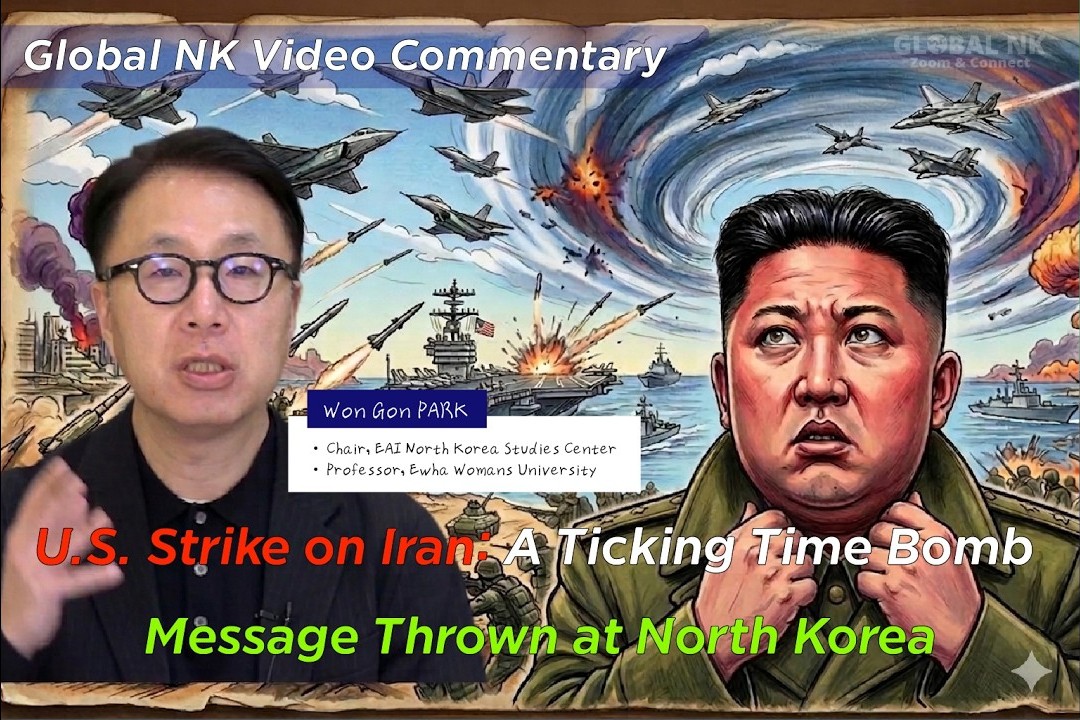
Kyung-young CHUNG, President of the Korea Unification International Working Group, assesses that the security of the Korean Peninsula is more grave than ever before. The current situation is one wherein the possibilities of a preemptive nuclear strike by North Korea or a preemptive strike by the United States cannot be excluded. The author realistically demonstrates how such contingencies would unfold. He asserts that, in the event of a preemptive strike by either party on the Korean Peninsula, the outcome will result in devastating the Korean Peninsula. He argues that it is imperative to seek a pathway to fundamentally prevent warfare. Professor Chung posits that the state leaders of South and North Korea as well as the U.S. and China must convene together to conclude a non-aggression declaration and a peace treaty.
■ See Korean Version on EAI Website
North Korea, at the Party Plenary Session in 2023, introduced the concept of “two hostile states.” This does not mean an abandonment of unification; rather, it means that the Republic of Korea is designated as the principal enemy to be annihilated and that territorial completion will be achieved through nuclear missiles. The U.S., following the extradition of Venezuelan President Maduro, joined forces with Israel to kill Iran's Supreme Leader Khamenei in an airstrike and has been carrying out large-scale offensive operations. Should the U.S. emerge victorious from this war, the possibility of a preemptive strike against North Korea cannot be ruled out. A preemptive nuclear missile strike by North Korea or a U.S. preemptive strike against North Korea would constitute a catastrophe for the Korean Peninsula. Now is precisely the historical inflection point at which a great transformation must occur—from the crisis of mutual destruction of South and North Korea toward the peaceful unification of the Korean Peninsula.
Under this situational awareness and historical consciousness, this commentary seeks to conduct a theoretical examination of preemptive strikes and subsequently to posit possible scenarios of North Korea's preemptive nuclear strike against the South and a U.S. preemptive strike against North Korea, and to assess the resulting end states should such strikes be executed. Finally, this article seeks to explore a strategy for realizing a unified Korea, which is the path to escaping such a crisis and preventing a national catastrophe.
I. Theoretical Examination of Preemptive Strikes
A preemptive strike is defined as "an act of attack undertaken at the level of self-defense in order to seize the initiative against the enemy when an enemy’s intent to commence hostilities is clear."[1] A preemptive strike in which one strikes the adversary first when attack indicators are evident is―unlike a preventive strike in which one strikes preemptively in anticipation of a future threat―a legally legitimate and justifiable anticipatory action under international law.[2] A preventive strike constitutes illegal excessive self-defense, in that it targets specific military installations of the adversary in peacetime out of concern that one's position will become increasingly disadvantageous over time.[3] Exceptionally, a preventive strike can be carried out against a tyrannical regime that violates human rights or threatens the rights to survival of its own people, provided that the UN Security Council adopts a resolution invoking the Responsibility to Protect (R2P).[4]
A preemptive strike—particularly a first strike when indicators of an attack using nuclear weapons are clear—constitutes a legitimate use of force. Given that the use of nuclear weapons would produce catastrophic consequences, it is meaningful to examine the effective means of implementing a preemptive strike against North Korea, on the grounds that the prior use of force to preempt such an attack is warranted.[5] Although there are critical views regarding the U.S. conduct, discussions on preemptive strikes remain active and the possibility of future preemptive strikes cannot be excluded.[6]
Both preventive strikes and preemptive strikes share the commonality that they involve taking military action prior to the adversary state, but they differ in that a preemptive strike is executed in a situation where the adversary's armed attack is imminent, whereas a preventive strike is a military action undertaken in the absence of a current threat, aimed at eliminating a greater threat anticipated to materialize in the future.
II. Preemptive Strike Scenarios
1. North Korea's Strategy of Armed Unification through a Nuclear Preemptive Strike
The near-term objective of North Korea's nuclear and missile policy is to achieve the status of a nuclear-armed state—akin to India and Pakistan—by acquiring miniaturized nuclear warheads and the technical capability for ICBM atmospheric reentry. As a medium-to-long-term objective, while retaining a certain quantity of nuclear weapons as a nuclear-armed state, North Korea seeks the lifting of sanctions against it and economic compensation under the pretext of cooperating in reducing and non-proliferating the remainder, and the withdrawal of U.S. forces from South Korea (USFK) and the dissolution of the United Nations Command. Ultimately, it intends to launch a preemptive strike with nuclear missiles and, through a "Great War of Unification," complete the realization of "Kim Il-sungism" and "Kim Jong-ilism" across the entire Korean Peninsula.[7]
North Korea's military strategy and preemptive strike capability can be inferred through analysis of strategic lines, military capabilities, military command structure, war plans, training patterns, and missile test patterns. The Korean People's Army pursues four major strategic lines: political-ideological strengthening of the armed forces, moral strengthening of the armed forces, tactical strengthening of the armed forces, and multi-branch strengthening of the armed forces. In 2022, North Korea enacted the Law on Nuclear Forces Policy, which specifies the conditions for the use of nuclear weapons. The Korean People's Army is exploring various strategies and tactics based on its military strategy of surprise attack, combined operations, and rapid decisive operations, as well as its nuclear force strategy.
North Korea possesses the capabilities to employ such strategies and tactics, holding 1.28 million regular troops, 7.62 million reservists consisting of the Worker-Peasant Red Guards, the Korean People's Internal Security Forces, and the Young Red Guards, Special Operations Forces and the Storm Corps;[8] approximately 50 nuclear warheads and sufficient nuclear fusion material to produce up to 40 additional warheads.[9] It possesses a three-component missile set capable of simultaneously striking the Korean Peninsula, Guam, and the Continental U.S.(CONUS) : the short-range ballistic missile (SRBM) Hwasong-11Ma, specialized for attacking the Korean Peninsula; the hypersonic intermediate-range ballistic missile (IRBM) Hwasong-16, capable of striking Guam; and the ICBM Hwasong-20, capable of striking the CONUS.[10]
In addition, North Korea possesses 600mm super-large multiple rocket launchers with a range of 420km; over 8,800 artillery pieces and over 5,500 multiple rocket launchers and rocket artillery of 240mm caliber and above deployed in forward areas capable of launching surprise concentrated massed fire on the Seoul metropolitan area and central regions; over 6,900 tanks and armored vehicles capable of high-speed maneuver warfare; 420 warships and 70 submarines; 810 combat aircraft and 290 helicopters; and approximately 6,800 cyber warfare personnel.[11]
Furthermore, North Korea has been conducting commander maneuver training exercises for territorial expansion, deploying tactical nuclear units on a regular basis, including through: expanding asymmetric drone capabilities and adjusting flight trajectories post-infiltration; a seven-day war plan;[12] the movement of North Korean forces identified during the declaration of a quasi-wartime state on August 20, 2015; 21st Century modern warfare combat experience gained from the Russia-Ukraine War; and the protracted garbage-filled balloon campaign toward the South from May 28 to November 28, 2024.[13] Analysis of North Korea's ballistic missile launch records over the past five years reveals that 78 missile test launches were conducted. Of these, 38 were launched from the vicinity of Pyongyang—the greatest number—30—were launched toward the East Sea. SRBMs accounted for 45 launches, and in 2022, an ICBM was launched on the longest trajectory of 4,500 km.[14] Assuming these missile and rocket artillery launches were conducted with adjusted elevation angles and firing directions, this amounts to what would be precisely striking High-Payoff Targets such as Guam, U.S. military bases in Japan, and the ROK Army, Navy, and Air Force bases in South Korea—as if rehearsing for war.
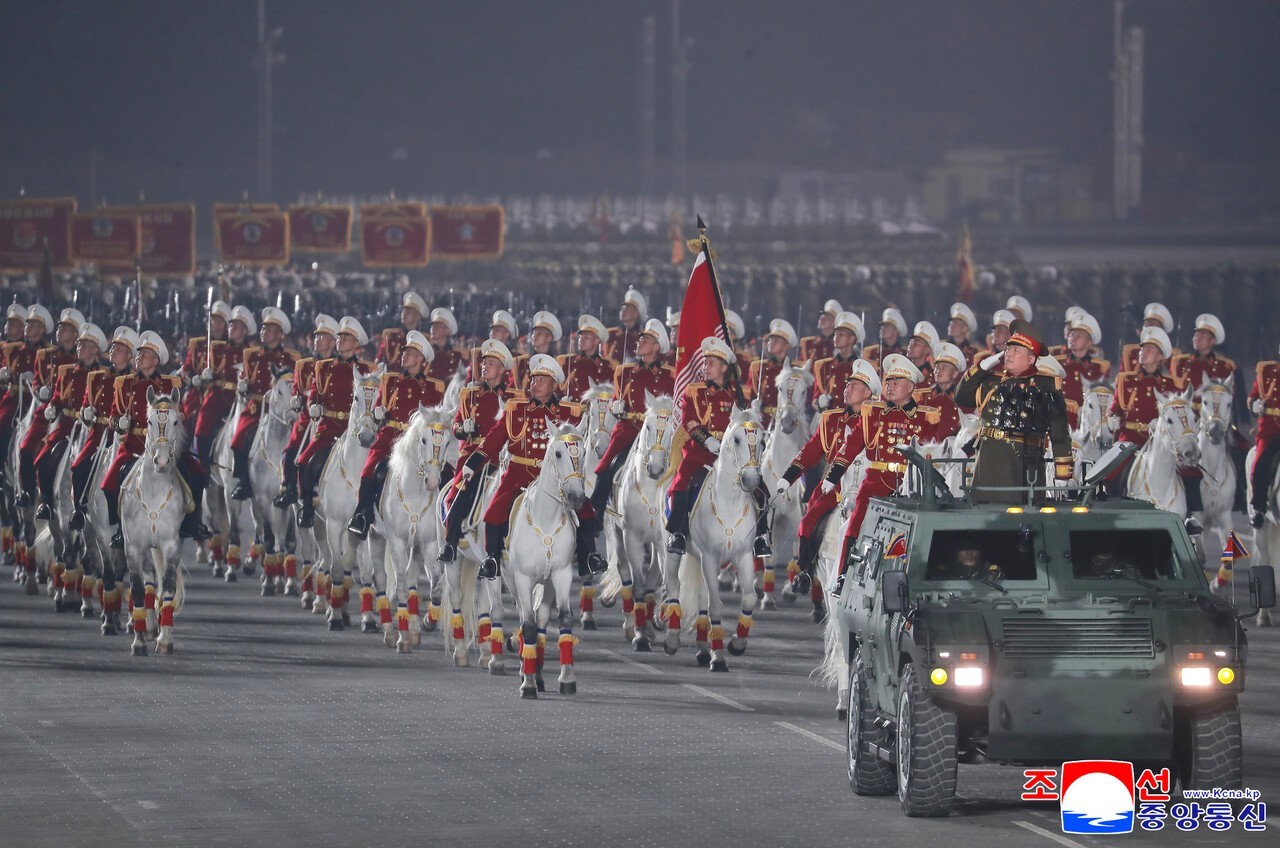
As a characteristic of North Korea's military command structure, Kim Jong Un, as Chairman of the State Affairs Commission and Supreme Commander, exercises operational command over subordinate Korean People’s Army through the General Staff Department under the guidance of the State Affairs Commission, and exercises full authority over military affairs in emergencies. The Korean People's Army maintains a unified command system from the Chairman of the State Affairs Commission as well as Supreme Commander of the KPA through the chain of command of the General Staff Department, consisting of Army, Special Operations Forces, Navy, Air Force, and Strategic Rocket Forces. The Army is organized into 10 corps, the 91st Capital Defense Corps, the Anti-Aircraft Artillery Corps, an armored division, 5 mechanized infantry divisions, and 1 mechanized artillery division. Seventy percent of Army forces are forward-deployed south of the Pyongyang–Wonsan line, maintaining a posture of readiness for preemptive attack.
[Figure] North Korea's Military Command Structure

Source: Ministry of National Defense, Republic of Korea, 2022 Defense White Paper (Ministry of National Defense, 2023), p. 26.
North Korea first seeks to strike the naval and air force deployment bases of U.S. forces in Japan, from which U.S. reinforcement forces would be sortied, as well as Guam, Hawaii, Alaska, California, and other launch bases, using long-range ballistic missiles such as SRBM, IRBM, and ICBMs, thereby cutting off reinforcement forces to the Korean Peninsula. Subsequently, it launches a nuclear preemptive strike with hypersonic missiles armed with tactical nuclear weapons to neutralize South Korea's war leadership and the command and control of the ROK-U.S. Combined Forces Command.
While devastating the core capabilities across South Korea with 600mm super-large multiple rocket launchers, North Korea intends to breach the DMZ with mechanized forces, envelop and bypass the Seoul metropolitan area, advance southward, and employ combined tactics between internal collaborative forces within South Korea and forces inserted for a second front, thereby seizing control of the entire Korean Peninsula.
2. Scenario for a Preemptive Strike Against North Korea
The scenario for a preemptive strike against North Korea can be inferred from three precedents: the 1994 plan for a precision surgical strike against the Yongbyon nuclear facility; the November 30, 2017 power projection, in which two U.S. aircraft carrier strike groups and dozens of strategic bombers deployed to the East Sea; and the ongoing U.S.-Iran War in which the U.S. and Israeli forces are conducting military operations through a preemptive strike against Iran.
(1) Case Study: Suspension of the 1994 Yongbyon Nuclear Facility Precision Strike Plan
The suspension of the 1994 precision strike plan against the Yongbyon nuclear facility has significant implications for pursuing preemptive strikes. Despite international pressure urging North Korea to halt its nuclear development, North Korea threatened to eject IAEA nuclear inspectors, unilaterally extracted nuclear fuel rods, and continued its nuclear development while threatening that Seoul would become a "sea of fire." The military confrontation escalated. When the U.S. and its allies urged the UN Security Council to impose sanctions, North Korea insisted that "sanctions are tantamount to a declaration of war." The U.S. moved to pursue a precision strike against the Yongbyon nuclear facility, anticipating that the situation would become uncontrollable if North Korea were allowed to continue developing its nuclear capabilities at Yongbyon.[15]
The U.S. Department of Defense accelerated the force buildup on the Korean Peninsula and surrounding region that it had been quietly pursuing for several months. In the first phase, in addition to U.S. forces stationed in Korea, approximately 1,000 logistics personnel responsible for receiving, staging, onward movement, and integration (RSOI) of operational planning personnel and reinforcement forces at ROK naval and air force bases were deployed.
In the second phase, by mid-April 1994, Patriot batteries, Apache attack helicopters, Bradley infantry fighting vehicles, counterfire radars, spare aircraft parts, new ammunition-loading equipment, and other counter-fire capabilities were successively deployed to the Korean Peninsula to neutralize the long-range artillery concentrated in the Seoul metropolitan area anticipated in the event of a precision strike, and other combat heavy equipment was loaded aboard maritime transport vessels on standby. The third phase called for the deployment of additional forces from the Marine Expeditionary Force and Army argumentation corps.
On the morning of June 14, 1994, President Bill Clinton convened a meeting at the White House with Secretary of Defense William Perry and Commander of U.S. Forces Korea Gary Luck to receive a briefing on the three-phase reinforcement plan and deliberate on its execution.[16] At precisely that same time, in Pyongyang, a special envoy of President Jimmy Carter was engaged in backchannel negotiations with Kim Il-sung. As a result, an agreement was reached that included explicit consent to freeze the nuclear development program—including a ban on loading new fuel rods into the 5MW reactor and a ban on reprocessing spent fuel rods—along with allowing IAEA inspection personnel to remain, and Kim Il-sung signed the agreement, bringing the military action of a precision strike against Yongbyon to a halt.
(2) Case Study: The 2017 U.S. Power Projection Against North Korea
As another case study, on November 30, 2017, two aircraft carrier strike groups and some B-2 stealth strategic bombers deployed to the East Sea in order to eliminate the Kim Jong Un regime and North Korea's nuclear missiles, pushing the situation to the brink of war.
In March 2017, President Trump, chairing the National Security Council, assessed that North Korea would neither collapse nor reform, and decided to abandon the failed policy of strategic patience and pursue a maximum pressure policy in order to avoid repeating the mistakes of the past. The principle was established that sanctions would not be lifted until negotiations with North Korea yielded rewards or complete denuclearization was achieved.[17]
When North Korea launched the intercontinental ballistic missile Hwasong-14 on July 4, 2017—U.S. Independence Day—tensions between North Korea and the U.S. escalated, and following the sixth nuclear test on September 3, successive meetings were held of the Policy Coordination Committee, the Deputies Committee, and the Principals Meeting regarding North Korea policy. The Kim Jong Un regime, as a present threat to U.S. national security, was testing nuclear missiles capable of striking the CONUS. On October 17–19, 2017, the U.S. conducted bombing exercises with a formation of strategic bombers at the Ozarks training range in Missouri, an area similar to North Korea's terrain.
Kim Jong Un announced via a report on November 19, 2017 that the ICBM Hwasong-15 had been test-launched on a maximum-range trajectory at a high elevation angle from Pyongyang International Airfield on November 18, 2017, and declared the completion of the state's nuclear armament. On November 30, the Trump administration, which had pursued the hardest-line policies symbolized by maximum pressure and the "Fire and Fury" policy,[18] took advantage of the cover of darkness to deploy two aircraft carrier strike groups, B-2 stealth bombers, attack submarines, and F-22 squadrons into international waters in the East Sea near North Korea. The posture was one of merciless retaliation should North Korea resort to armed action under any circumstances. When North Korea did not budge in the face of this large-scale power projection, the U.S. withdrew the deployed forces.[19]
(3) Scenario for a Preemptive Strike Against North Korea
In accordance with the Camp David Declaration of August 18, 2023,[20] in which the leaders of the ROK, the U.S., and Japan agreed that the three nations would jointly respond to challenges, provocations, and security threats in the region, the ROK, U.S., and Japan may participate in a preemptive strike against North Korea; however, South Korea is assumed not to participate, out of concern that a preemptive strike would trigger North Korean retaliation and escalate into a full-scale war.
The grounds and justification for a preemptive strike are more than sufficient. Since the Korean War, North Korea has repeatedly committed infiltrations and local provocations in violation of the Armistice Agreement. These include: the January 21, 1968, attempted raid on the Blue House or President Office, the November 1968 armed infiltration in Uljin-Samcheok, the 1983 Rangoon bombing, the 1987 bombing of Korean Air Flight 858, the 1996 armed guerilla infiltration by submarine in the Gangneung area, the First Naval Crash of Yeonpyeong in 1999, the Second Naval Clash of Yeonpyeong in 2002, the March 2010 sinking of ROKS Cheonan, the November 2010 shelling of Yeonpyeong Island, the 2015 landmine incident, the 2024 garbage balloon incident, and the frequent violations of the Military Demarcation Line within the Demilitarized Zone from 2025 to the present—altogether 3,121 violations of the Armistice Agreement, including 2,022 infiltrations and 1,119 local provocations.[21]
Moreover, Americans have been killed as a result of North Korea's unceasing hostile acts. In the Korean War, which broke out with North Korea's southward invasion, a cumulative total of approximately 4.85 million personnel (Army 2.83 million, Navy 1.60 million, Air Force 420,000) participated, suffering 54,246 killed in action and 468,659 wounded in action. In the 1968 USS Pueblo incident, one U.S. Navy intelligence ship crew member was killed and 82 others were detained for 11 months before being released. In 1969, North Korea shot down a U.S. Navy EC-121 reconnaissance aircraft over the East Sea, killing all 31 crew members; and in the 1976 Panmunjom axe murder incident, two U.S. Army officers were killed. In 2016, North Korea released the detained American youth Otto Warmbier in a comatose state, but he died after returning home.
North Korea's weapons of mass destruction (WMD) and missile programs, its highly advanced conventional military capabilities, cyber activities, real combat experience gained from the Russia-Ukraine War, and ICBM flight tests capable of reaching every corner of the U.S. mainland[22] constitute a direct threat to the U.S.
North Korea's hostile acts have also caused great harm to Japan, and Japan is under the direct threat of North Korea's nuclear missiles. From 1959 to 1984, North Korea and the General Association of Korean Residents in Japan (Chongryon) promoted a program to relocate pro-North Korea Koreans residing in Japan and their families from Japan to North Korea. Through this program, 93,340 people were transferred to North Korea between 1959 and 1967. North Korea, having received back the repatriated Korean-Japanese, subsequently discriminated against them in violation of its promises, and effectively abducted and confined them by preventing their return to Japan and restricting them to designated locations.[23] Furthermore, North Korea perpetrated 12 cases of abductions involving 17 individuals by North Korean agents and others during the 1970s and 1980s. North Korea has officially acknowledged the abduction of 13 of these Japanese nationals, and 5 have returned to Japan, but regarding the remaining 12, it claims that "8 have died and 4 are unconfirmed."[24] Japan is also under the direct threat of North Korea's nuclear weapons and intermediate-range ballistic missiles.
Under Kim Jong Un’s tyrannical regime, 25 million North Korean citizens are living with their human rights violated and struggling for survival.
Attempts have been made to pursue North Korea's nuclear dismantlement through negotiations, but North Korea has not complied and has continued to advance its nuclear and missile capabilities. The U.S. and Japan launched a large-scale offensive operation on D-Day, D-Month, H-Hour in order to remove the Kim Jong Un regime and liberate North Korea, and to eliminate the nuclear missiles threatening international peace. The targets of attack included: Kim Jong Un's command facilities and nuclear missile bases, naval and air force bases and military airfields, special operations forces and Storm Corps launch bases, ammunition, missile, and drone facilities, and key military infrastructure including power generation facilities.
U.S.-Japan combined forces conducted intensive strikes to establish air superiority, and in maritime operations, U.S. Navy vessels attacked North Korean warships, destroying most of North Korean naval forces in the opening phase of the war, conducting multi-domain operations simultaneously in the air and at sea. It was a method of selectively striking targets by combining precision strike capabilities with intelligence assets. In this scenario, the following unfolds: B-2 stealth bombers dropped dozens of 2,000-pound bombs to neutralize missile launch pads throughout North Korea. Kim Jong Un and the leadership, who had dominated for 15 years, were killed by GBU-72 bunker-busting earth-penetrating bombs, and not only nuclear weapons and missiles but also uranium enrichment and ballistic missile manufacturing facilities were destroyed. A less hostile leader emerged, negotiations were conducted, and an end-of-war declaration was made.
(4) Assessment
Although it is true that the Trump administration favors leadership elimination operations, places emphasis on limited military options, and has reduced the War Powers Resolution to a mere procedural formality, some experts believe that these factors merely stimulate North Korea's perception of crisis without significantly raising the probability of a U.S. preemptive strike against North Korea.[25] This is because the U.S. is unwilling to accept the risk of North Korean nuclear retaliation; the probability of Chinese and Russian intervention is high, which could escalate the conflict into a great-power confrontation; the execution of a decapitation operation without South Korea's consent would result in extreme North Korean retaliatory damage to South Korea; and the difficulty of locating North Korea's leadership could significantly lower the probability of operational success.
However, in the unlikely event that indicators of a U.S. preemptive strike are detected, Kim Jong Un himself may strike first. Kim Jong Un's fear of a preemptive strike is not simply a product of psychological anxiety or personal disposition; rather, it is a structural and cognitive phenomenon formed by the complex interaction of the structural characteristics of the North Korean political system, in which the survival of the leader is equated with the survival of the regime, the overwhelming military capabilities and precision strike capacity of the U.S., the unpredictability of President Trump, and the contagion effect of the successful leadership elimination operations that occurred in Iran and Venezuela. In particular, the successful eliminations of Venezuelan President Maduro and Iran's Supreme Leader Khameini have functioned as empirical signals to North Korea that "the U.S. actually executes leadership elimination when necessary," becoming a catalyst that qualitatively transforms Kim Jong Un's structure of fear.
Whether North Korea launches a preemptive nuclear strike or the U.S. leads a preemptive strike against North Korea, neither side will emerge with a complete victory. If North Korea launches a preemptive strike with tactical nuclear weapons and the firepower of 13,300 artillery pieces and multiple rocket launchers, can the ROK-U.S. Combined Forces be annihilated instantly? The ROK military will not only respond in near-real time to North Korea's nuclear missile attacks with the Kill Chain and Korea Air and Missile Defense (KAMD) capabilities, but the ROK-U.S. Combined Forces will also conduct conventional-nuclear integration (C&NI) operations together with massive retaliatory operations capable of devastating North Korea's war command. North Korea's military can never achieve victory.
Even in the event of a U.S.-led preemptive strike supported, the possibility cannot be excluded that North Korean forces, joined by Russian Northern Fleet and Chinese People’s Liberation Army Northern Theater Command, may conduct retaliatory operations. It is possible that they could launch a nuclear retaliatory strike against Japan as well as the U.S. with IRBMs, and fire ICBMs armed with strategic nuclear warheads to devastate Tokyo and Washington. A one-sided victory for the ROK-U.S.-Japan Combined Forces cannot be guaranteed.
Regardless of any preemptive strikes, a complete victory cannot be guaranteed. The probability of mutual annihilation for either the striker or the struck is far too great.
A simulation has shown that if a 20-kiloton nuclear warhead capable of maximum lethality were to detonate at 800 meters above around Yongsan in Seoul, there would be approximately 534,600 casualties, including approximately 114,600 killed.[26] The damage to the Seoul metropolitan area from an artillery and rocket artillery barrage of 13,300 pieces would be beyond imagination. Conversely, if the U.S. were to conduct a nuclear retaliation against Pyongyang, one-third of Pyongyang's 3.1 million residents would become casualties.
Under no circumstances must such a war be allowed to break out. South and North Korea, as well as the U.S. and China, must contemplate the path to escaping the crisis on the Korean Peninsula and preventing the war that would bring about the mutual destruction of South and North Korea.
III. Great Transformation toward Peaceful Unification
The security environment on the Korean Peninsula gives rise to the ominous prospect that war may break out. South and North Korea are each building up their military forces to protect themselves. As the arms race accelerates, in a situation where all channels between South and North Korea are severed, an accidental armed clash could escalate into war. Regardless of which side initiates war, the possibility cannot be excluded that, in the worst case, the conflict could escalate into a confrontation between the ROK-U.S.-Japan Combined Forces and North Korea-China-Russia forces.
It is imperative to carefully and seriously consider the path toward eliminating the threat of war and the fundamental prevention of national catastrophe. It is precisely the path of peaceful unification. If we invest for unification rather than exhausting our national energy in preparations for war, we will receive tremendous blessings. With unification, we will be liberated from the fear of war. By integrating South Korea's high-technology and capital with North Korea's labor and huge resources, rapid economic growth can be achieved. Goldman Sachs has forecasted that GDP of United Korea will outpace those of Japan and Germany in 2050.[27] Overcoming a history of trials and challenges—including colonial rule, the division of the Korean Peninsula, the Korean War, dictatorship, and poverty—the Republic of Korea has become an exemplary liberal democratic state, a top-ten economic and scientific-technological power, and a cultural powerhouse.
[Table] Comparison of South-North Korea National Power
Category
|
South Korea
|
North Korea
|
Ratio
|
GDP
|
$1,764.5 billion
|
$30.2 billion
|
58:1
Economic power:
South Korea 13th in the world, North Korea 145th
|
GNI
|
$36,194
|
$1,800
|
17:1
|
Trade
|
$1,275 billion
|
$3.25 billion
|
392:1
|
Population
|
51.75 million
|
25.25 million
|
2:1
|
Military Personnel
|
480,000
|
1.28 million
|
1:2.5
|
|
Defense Budget |
$45 billion |
$4 billion |
13:1 Military power: South Korea 5th in the world, North Korea 31st |
Source: Central Intelligence Agency, The CIA World Factbook 2025–2026 (Washington, D.C.: Skyhorse Publishing, 2025), p. 464; Global Firepower, "2026 Military Strength Ranking," https://www.youtube.com/watch?v=GSR8rtDjpbo (Accessed: March 20, 2026); Ministry of National Defense, 2022 Defense White Paper (Seoul: Ministry of National Defense, 2023), p. 290; South Korea's 2026 defense budget set at 66.2947 trillion won.
With unification, it will be possible to build an even more prosperous democratic civilized state. A unified Korean Peninsula will be transformed from a hotbed of conflict and disputes into a fountainhead of peace and co-prosperity. Furthermore, the unification of South and North Korea, which operate under different systems, holds profound historical and civilizational significance, as it would mark the definitive dismantlement of the Cold War Structure. Ten million separated families will be reunited. When South and North Korea are unified, the Korean Peninsula will become a logistical hub, and it may be possible to establish a Northeast Asian Economic Community and a Northeast Asian Security Cooperation Organization. The strategic benefits of unification overwhelmingly surpass the sum of the costs of division and the costs of unification, making it fully worthy of investment.
Military confidence-building measures must be pursued not only between South and North Korea but also between the U.S. and China. The heads of state of South Korea, North Korea, the U.S., and China must meet and declare the renunciation of war on the Korean Peninsula. In order to manage the unstable armistice structure, the North Korean and Chinese delegations must return to Panmunjom for the Military Armistice Commission to function properly. Progress must be made gradually and in stages from operational arms control toward structural arms control. Ultimately, a Korean Peninsula peace treaty among South Korea, North Korea, the U.S., and China could be concluded to establish a peace regime on the Korean Peninsula.[28]
IV. Conclusion: The Leaders of South Korea, North Korea, the U.S., and China Must Meet
The situation is one of heightened security crisis in which the possibility of war—whether an unexpected U.S.-led preemptive strike against North Korea, a North Korean nuclear preemptive strike, or an accidental or intentional war—cannot be excluded. Regardless of the nature of the war, it will not end in a one-sided victory but will inevitably result in mutual annihilation.
Under the threat of North Korea's nuclear missiles, South Korea must maintain a flawless ROK-U.S. combined war preparedness posture. In a severe situation where inter-Korean relations are severed, an accidental military clash could escalate into war. It is necessary to embark on the path to escaping the crisis on the Korean Peninsula and being liberated from the fear of war. Every effort must be made to prevent war. In times such as these, it is especially important that the leaders of South and North Korea meet. The direct hotline between the two leaders, and the military communication line, and the crisis management channel must all be restored; renegotiations for the restoration of the September 19 2018 Military Agreement must be conducted; a four-party declaration by South Korea, North Korea, the U.S., and China prohibiting the use of nuclear weapons on the Korean Peninsula must be made; and the North Korean and Chinese delegations to the Military Armistice Commission, which were withdrawn and recalled in 1994, must return.
Furthermore, the U.S. and China—which are directly and indirectly exerting influence over the fate of the Korean Peninsula and are parties to the peace agreement—and the leaders of South and North Korea, who are suffering from the division, must meet to find a path by which all can achieve a win-win outcome without going to war. If the leaders of South Korea, North Korea, the U.S., and China are of one mind, it will be possible to conclude a peace treaty on the Korean Peninsula and establish a peace regime. The leaders of South Korea, North Korea, the U.S., and China who will have led the unification of the Korean Peninsula will be recognized as figures who have contributed to human civilization. They will definitely receive the Nobel Peace Prize. ■
[1] Michael W. Doyle, Striking First: Preemption and Prevention in International Conflict (Princeton University Press, 2011).
[2] Karl P. Mueller, "Striking First: Preemptive and Preventive Attack in U.S. National Security Policy," http://www.rand.org (Accessed: March 20, 2026). Examples of preemptive strikes include Israel's 1967 Six-Day War, in which Israel struck first upon detecting signs of an Egyptian attack; examples of preventive strikes include the 2003 U.S.-led invasion of Iraq against a country developing WMDs.
[3] Chung Kyung-young, "Strategy for Neutralizing North Korea's Nuclear-Missile Threats," Korea Military, Vol. 1, Inaugural Issue (June 2017); Ryu Jae-gap, "Direction of Our Response to North Korea's Military Threats," Global Korea Strategy Forum, April 27, 2017.
[4] Peter Hilpold, ed., The Responsibility to Protect (R2P): A New Paradigm of International Law? (New York: Brill | Nijhoff, 2014): R2P was endorsed by all UN member states at the 2005 World Summit, and refers to the authority to take military action, pursuant to a UN Security Council resolution, against tyrannical regimes that commit massacres, ethnic cleansing, war crimes, and violations of human rights. In the first instance of its application, as casualties among innocent civilians rapidly increased due to the Libyan Civil War in March 2011, a R2P resolution was adopted against the Gaddafi regime, and NATO conducted military operations and eliminated Gaddafi.
[5] Kim Tae-sung, "A Study on the Limitations and Prerequisites of Preemptive Strike," Defense Policy Research, Vol. 108 (2015), cited; Kwon Hyuk-cheol, "A Study on Strategic Terminology of Preemptive Strike," Regular Course Thesis, Joint Staff College, Korea National Defense University (2009).
[6] Lawrence Freedman, Deterrence (Malden, MA: Polity Press, 2004).
[7] Chung Sang-don, "The Essence of the North Korean Nuclear Issue and China's Strategic Errors," KIDA, Weekly Defense Forum, No. 1618 (16-20), May 9, 2016.
[8] Ministry of National Defense, Republic of Korea, 2022 Defense White Paper (Seoul: Ministry of National Defense, 2023), p. 334.
[9] Stockholm International Peace Research Institute, SIPRI Yearbook 2025 (Oxford University Press, 2025).
[10] "North Korea Deploys Hypersonic Missiles to Penetrate South Korea's Air Defense Network," NK Chosun, October 13, 2025, https://nk.chosun.com/news/articleView.html?idxno=203219 (Accessed: March 20, 2026): In the event of an attack using a tactical nuclear warhead mounted on a hypersonic missile, flying at Mach 5 (6,120 km/h), it is capable of devastating all targets within a range of 130 km within one minute.
[11] Ministry of National Defense, Republic of Korea, 2022 Defense White Paper (Seoul: Ministry of National Defense, 2023).
[12] Chung Yong-su, "Kim Jong Un Devised a '7-Day War' Operations Plan," JoongAng Ilbo, January 18, 2015: North Korea has developed an operations plan to occupy all of South Korea within 7 days in order to prevent the U.S. from intervening in earnest in the event of a surprise southward invasion or a local conflict escalating into a full-scale war.
[13] Nilay TAVLI and Kyung-young CHUNG, "North Korea's Garbage-filled Balloons as a New Psychological Warfare," Global NK Commentary, East Asia Institute, Feb 18, 2025.
[14] Lee Hyun-ho, "Analysis of North Korea's Ballistic Missile Launch Status Over the Past Five Years," Seoul Economic Daily, January 12, 2026.
[15] Sydney Seiler, "Preemptive Strikes, Deterrence, and Denuclearization: Ascertaining Pyongyang's View of U.S. Use of Force Against Iran's Nuclear Program," Commentary by CSIS, July 17, 2025, https://www.csis.org/analysis/preemptive-strikes-deterrence-and-denuclearization-ascertaining-pyongyangs-view-us-use (Accessed: March 20, 2026).
[16] Don Oberdorfer, The Two Koreas: A Contemporary History (Reading, Massachusetts: Addison-Wesley, 1997), pp. 305–336.
[17] H. R. McMaster, Battleground: The Fight to Defend the Free World (New York: HarperCollins Publishers, 2020), p. 365.
[18] Michael Wolff, Fire and Fury (New York: Henry Holt and Company, 2018).
[19] Chung Kyung-young, "Prospects for Security Policy upon Trump's Return to Power and South Korea's Preparedness Strategy," Military Forum, Vol. 117 (Spring 2024).
[20] The White House, "The Spirit of Camp David: Joint Statement of Japan, the Republic of Korea, and the United States," Aug 18, 2023.
[21] Ministry of National Defense, Republic of Korea, 2022 Defense White Paper (Ministry of National Defense, 2023), p. 352.
[22] The U.S. Intelligence Community, 2026 Annual Threat Assessment, Mar 2026.
[23] Yoshiaki KIKUCHI, “The Repatriation Project of Koreans in Japan to North Korea and Media,” Annual Review of Migration Studies, Vol. 28(2022).
[24] “The 17 Japanese People Officially Recognized as Having Been Abducted by North Korea.” https://www.nippon.com/en/japan-data/h01839/ (Accessed: April 1, 2026).
[25] Kwak Tae-hwan, "Is a Decapitation Operation Against North Korea's Leadership Feasible? … Trump's Military Action and Kim Jong Un's 'Fear' of a Preemptive Strike," Breaking News, March 8, 2026.
[26] Lee Hyun-ho, "If a North Korean Nuclear Bomb Explodes 800 Meters Above Seoul … Up to 530,000 Casualties," Seoul Economic Daily, March 9, 2024.
[27] Goldman Sachs Global ECS Asia research. “ A United Korea? Reassessing North Korea Risks,” Global Economics Paper No. 188.
[28] Chung Kyung-young, South Korea: The Korean War, Armistice Structure, and A Peace Regime (Berlin: Lambert Academic Publishing, 2020), pp. 227–267; Chung Kyung-young, Peace Creation: The ROK-U.S. Alliance and Peace Building (Paju: Hanul, 2020), pp. 211–244.
Bibliography
Books (in Korean)
Ministry of National Defense, Republic of Korea, 2022 Defense White Paper (Ministry of National Defense, 2023).
Chung Kyung-young, Peace Creation: The ROK-U.S. Alliance and Peace Building (Paju: Hanul, 2020).
Articles (in Korean)
Chung, Kyung-young, "Strategy for Neutralizing North Korea's Nuclear-Missile Threats," Korea Military, Vol. 1, Inaugural Issue (June 2017).
_________________. "Prospects for Security Policy upon Trump's Return to Power and South Korea's Preparedness Strategy," Military Forum, Vol. 117 (Spring 2024).
Chung, Sang-don, "The Essence of the North Korean Nuclear Issue and China's Strategic Errors," KIDA, Weekly Defense Forum, No. 1618 (16-20), May 9, 2016.
Kwon, Hyuk-cheol, "A Study on Strategic Terminology of Preemptive Strike," Regular Course Thesis, Joint Staff College, Korea National Defense University (2009).
Kim, Tae-sung, "A Study on the Limitations and Prerequisites of Preemptive Strike," Defense Policy Research, Vol. 108 (2015).
Ryu, Jae-gap, "Direction of Our Response to North Korea's Military Threats," Global Korea Strategy Forum, April 27, 2017.
Newspapers and Internet (in Korean)
Chung, Yong-su, "Kim Jong Un Devised a '7-Day War' Operations Plan," JoongAng Ilbo, January 18, 2015.
Kwak, Tae-hwan, "Is a Decapitation Operation Against North Korea's Leadership Feasible? … Trump's Military Action and Kim Jong Un's 'Fear' of a Preemptive Strike," Breaking News, March 8, 2026.
Lee, Hyun-ho, "If a North Korean Nuclear Bomb Explodes 800 Meters Above Seoul … Up to 530,000 Casualties," Seoul Economic Daily, March 9, 2024.
__________. "Analysis of North Korea's Ballistic Missile Launch Status Over the Past Five Years," Seoul Economic Daily, January 12, 2026.
"North Korea Deploys Hypersonic Missiles to Penetrate South Korea's Air Defense Network," NK Chosun, October 13, 2025, https://nk.chosun.com/news/articleView.html?idxno=203219 (Accessed: March 20, 2026).
Books
Central Intelligence Agency, The CIA World Factbook 2025–2026 (Washington D.C.: Skyhorse Publishing, 2025).
Chung, Kyung-young, South Korea: The Korean War, Armistice Structure, and A Peace Regime (Berlin: Lambert Academic Publishing, 2020).
Doyle, Michael W., Striking First: Preemption and Prevention in International Conflict (Princeton: Princeton University Press, 2011).
Freedman, Lawrence, Deterrence (Malden, MA: Polity Press, 2004).
Hilpold, Peter, ed., The Responsibility to Protect (R2P): A New Paradigm of International Law? (New York: Brill | Nijhoff, 2014).
McMaster, H. R., Battleground: The Fight to Defend the Free World (New York: HarperCollins Publishers, 2020).
Oberdorfer, Don, The Two Koreas: A Contemporary History (Reading, Massachusetts: Addison-Wesley, 1997).
Stockholm International Peace Research Institute, SIPRI Yearbook 2025 (London: Oxford University Press, 2025).
The U.S. Intelligence Community, 2026 Annual Threat Assessment, Mar 2026.
Wolff, Michael, Fire and Fury (New York: Henry Holt and Company, 2018).
Academic Articles
Goldman Sachs Global ECS Asia research. “A United Korea? Reassessing North Korea Risks,” Global Economics Paper No. 188.
Kikichi, Yoshiaki, “The Repatriation Project of Koreans in Japan to North Korea and Media,” Annual Review of Migration Studies, Vol. 28(2022).
The White House, "The Spirit of Camp David: Joint Statement of Japan, the Republic of Korea, and the United States," Aug 18, 2023.
Tavili, Nilay and Kyung-young Chung, "North Korea's Garbage-filled Balloons as a New Psychological Warfare," Global NK Commentary, East Asia Institute, Feb 18, 2025.
Internet
Global Firepower, “2026 Military Strength Ranking,” https://www.globalfirepower.com/ (Accessed: March 20, 2026).
Mueller, Karl P., "Striking First: Preemptive and Preventive Attack in U.S. National Security Policy," http://www.rand.org (Accessed: March 20, 2026).
Seiler, Sydney, "Preemptive Strikes, Deterrence, and Denuclearization: Ascertaining Pyongyang's View of U.S. Use of Force Against Iran's Nuclear Program," Commentary by CSIS, July 17, 2025, https://www.csis.org/analysis/preemptive-strikes-deterrence-and-denuclearization-asce rtaining-pyongyangs-view-us-use (Accessed: March 20, 2026).
“The 17 Japanese People Officially Recognized as Having Been Abducted by North Korea.” https://www.nippon.com/en/japan-data/h01839/ (Accessed: 2026. 4. 1).
■ Kyung-young CHUNG is the President of the Korea Unification International Working Group .
■ Translated and edited by Sangjun LEE, EAI Research Associate; Inhwan OH, EAI Senior Research Fellow.
For inquiries: 02 2277 1683 (ext. 211) | leesj@eai.or.kr